Wet and contaminated floors
Spills, tracked-in water, leaks, grease, food, cleaning solution, condensation, and other substances can create hazards in stores, restaurants, hotels, apartment buildings, and common areas.
Slip & falls · Premises liability
A slip, trip, or fall can happen in seconds and produce injuries that last for months or years. What looks simple afterward may be difficult to prove once a spill is cleaned, a defect is repaired, or surveillance video is overwritten.
At the same time, a property owner is not automatically responsible whenever someone is hurt. The case must be built around the condition, who controlled the property, what that person or business knew or should have known, and how the incident caused the injury.
The evidence—not stereotypes about fall cases—should decide the claim.
Call (305) 793-8687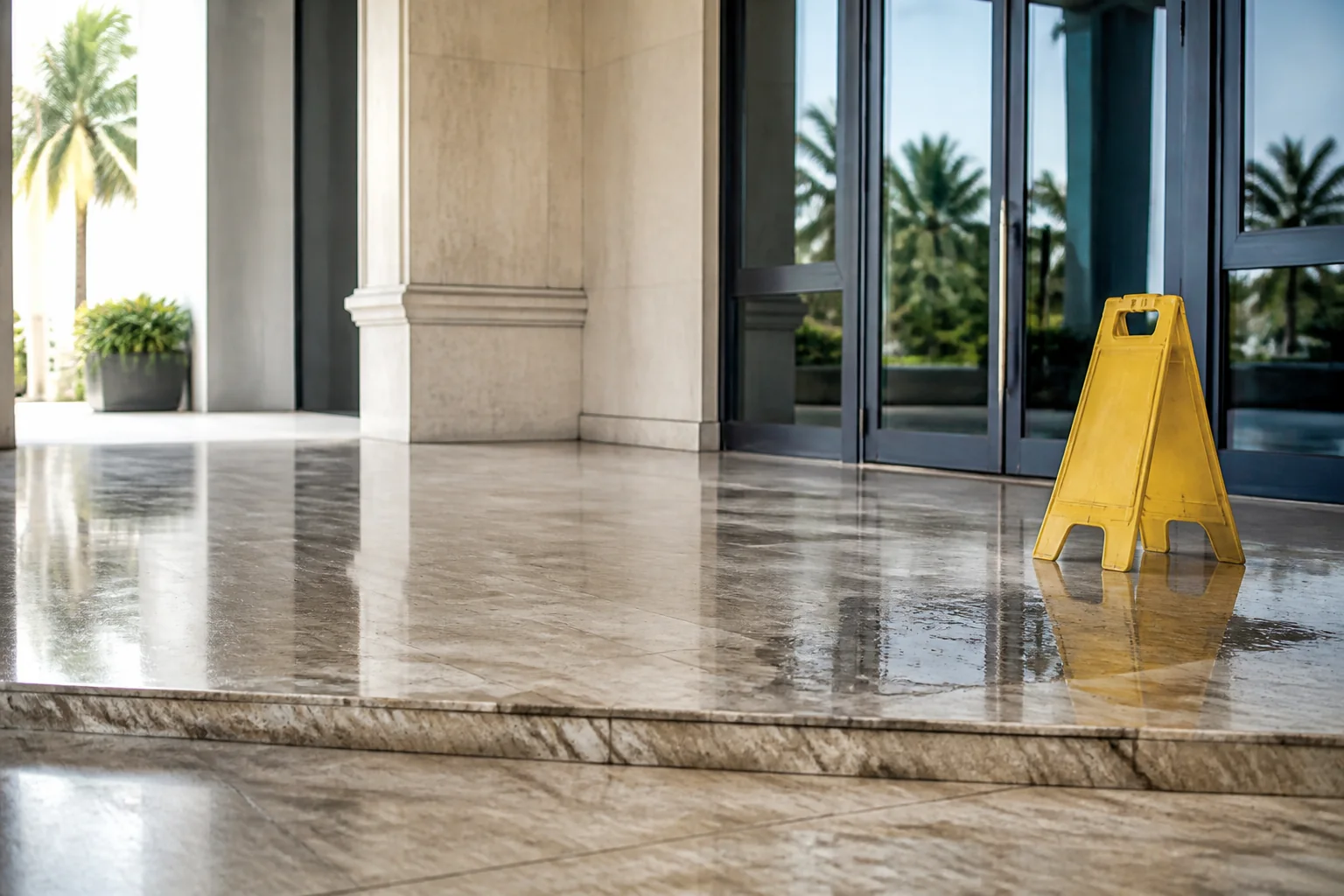
How a slip-and-fall lawyer can help
The Law Offices of Manny Arce evaluates whether the property was unreasonably dangerous, who possessed or controlled the area, whether legally sufficient notice can be proven, and whether the medical evidence connects the incident to the claimed harm.
Unsafe property conditions
Spills, tracked-in water, leaks, grease, food, cleaning solution, condensation, and other substances can create hazards in stores, restaurants, hotels, apartment buildings, and common areas.
Potholes, broken pavement, uneven transitions, loose mats, poor drainage, unmarked changes in elevation, and inadequate lighting can contribute to falls.
Broken steps, missing or unstable handrails, code issues, poorly designed transitions, falling merchandise, and deteriorated building components may require technical investigation.
A recurring leak, worn surface, unrepaired defect, or inadequate inspection practice may provide evidence about how the condition developed and whether it should have been corrected.
A warning must be evaluated in context. Its placement, visibility, timing, wording, and relationship to the actual danger may determine whether it reasonably addressed the risk.
Assaults or other criminal acts on property raise distinct questions about foreseeability, security measures, statutory protections, and causation. They are not ordinary slip-and-fall cases.
The notice question
When a person slips on a transitory foreign substance in a business establishment, Florida law generally requires proof that the business had actual or constructive knowledge of the condition and should have acted. Constructive knowledge may be supported by evidence that the condition existed long enough to be discovered or occurred with enough regularity to be foreseeable.
That is why details matter: footprints or track marks, drying patterns, recurring leaks, inspection timing, employee proximity, prior reports, surveillance, and the business’s customary practices can change the analysis. No single fact decides every case.
What to do after a fall
Obtain appropriate medical attention. If possible, photograph the exact condition and the surrounding area from several angles before it is cleaned, repaired, or removed. Include warnings—or the absence of warnings—lighting, displays, walking paths, and anything that obstructed the view.
Report the incident to the owner or manager and request a copy of the report, but do not guess about details you do not know. Identify witnesses. Preserve the shoes and clothing in their existing condition. Save receipts, location history, messages, and every communication from an insurer.
Potential losses may include medical expenses, future care, lost income, reduced earning ability, disability, and pain and suffering when supported by the facts and Florida law.
Common questions
No. A claim generally requires proof of a dangerous condition, a legally recognized duty, a breach of that duty, causation, and damages. For a transitory foreign substance in a Florida business, the injured person must ordinarily prove that the business had actual or constructive knowledge of the condition.
Notice may be shown through direct evidence or through facts indicating that the condition existed long enough that it should have been discovered, or that it occurred with enough regularity to be foreseeable. Inspection records, video, photographs, employee testimony, and prior incidents may matter.
Photograph or record the condition, surrounding area, warnings, footwear, and injuries. Report the incident, request the report, identify witnesses, preserve clothing and shoes, keep receipts or location records, and obtain appropriate medical care.
Visibility of a condition can affect duty and comparative fault, but it does not automatically resolve every Florida premises claim. The analysis depends on the condition, foreseeability, reason for encountering it, property controller’s conduct, and other facts.
No. A negligent-security case usually focuses on whether criminal conduct was reasonably foreseeable and whether legally required security measures were unreasonably deficient. Florida has specific rules affecting these claims, so they require a separate factual and legal analysis.
A free, confidential consultation can address the property, notice evidence, responsible parties, injuries, and immediate preservation needs.
This information is general and is not a prediction of responsibility or outcome. Premises claims are fact-specific.
Clear fee policy
Personal injury matters are handled on a contingency-fee basis. Attorney’s fees and reimbursement of advanced case costs are paid only from a recovery obtained through settlement or verdict, as provided in the written fee agreement.