Left-turn collisions
A driver turning across oncoming traffic may misjudge the motorcycle’s distance or speed—or fail to see it at all. Signal timing, sight lines, lighting, and vehicle movement require careful review.
Motorcycle accidents
Motorcycles offer freedom, efficiency, and a direct connection to the road. They also leave riders exposed when a driver turns across their path, changes lanes without looking, follows too closely, or fails to respect their right to the lane.
After a crash, the physical recovery can be long and painful. At the same time, an insurer may try to reduce the case to a stereotype about motorcycles instead of examining what the driver actually did.
The evidence should decide what happened.
Call (305) 793-8687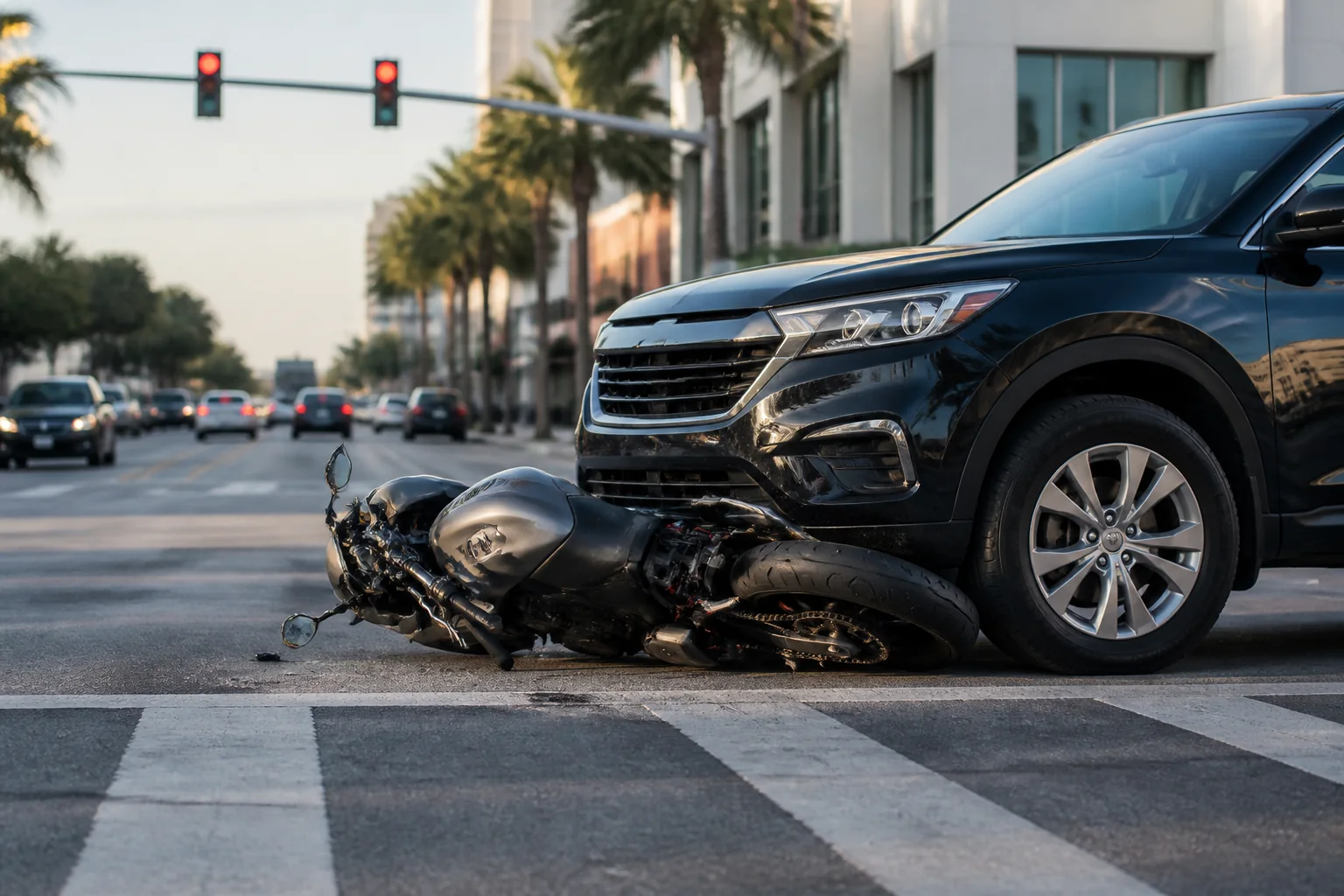
How a motorcycle accident lawyer can help
The Law Offices of Manny Arce investigates the roadway, vehicles, sight lines, movements, witnesses, and available electronic evidence. The firm also develops the medical and financial proof necessary to explain an injury that may affect mobility, work, appearance, independence, and everyday life.
Common causes
A driver turning across oncoming traffic may misjudge the motorcycle’s distance or speed—or fail to see it at all. Signal timing, sight lines, lighting, and vehicle movement require careful review.
A motorcycle can disappear from an inattentive driver’s mirrors. Failure to check a blind spot, signal, or maintain a lane can force a rider into another vehicle or off the road.
A rear impact that causes minor damage between cars can throw a rider from the motorcycle. Traffic flow, braking, distraction, and stopping distance may establish responsibility.
Drivers leaving parking lots, driveways, side streets, or stop signs may enter the rider’s path without allowing enough time or distance to avoid the collision.
Alcohol, drugs, phones, navigation screens, passengers, and fatigue can delay the recognition of a smaller vehicle and reduce reaction time.
Debris, potholes, poor drainage, construction conditions, defective components, or inadequate maintenance may contribute and require investigation beyond the drivers.
Florida motorcycle issues
Florida’s insurance framework does not treat motorcycles exactly like many four-wheel motor vehicles. A rider should not assume that ordinary automobile personal-injury-protection benefits apply in the same way. The motorcycle policy, household policies, vehicle ownership, and available uninsured or underinsured motorist coverage should be reviewed promptly.
Florida does not permit operating a motorcycle between lanes of traffic. But an alleged traffic violation does not automatically decide causation or fault. The question is how each person’s conduct contributed to the collision and injuries under the evidence and current comparative-fault law.
The injury picture
Motorcycle collisions can cause traumatic brain and spinal injuries, fractures, amputations, internal injuries, ligament and tendon damage, burns, road rash, scarring, and death. Even an injury described as “orthopedic” may require surgery, prolonged rehabilitation, work restrictions, or lifelong changes.
A supported claim may include medical expenses, future treatment, lost income, reduced earning ability, disability, pain and suffering, scarring, and property losses. The available recovery depends on fault, causation, insurance, the injuries, and governing law.
Obtain appropriate medical attention, report the collision, identify witnesses, photograph the scene and vehicles, and preserve the motorcycle and gear. Do not give a broad recorded statement or sign a final release without understanding its effect.
Common questions
Motorcyclists have less physical protection, crashes often cause severe injuries, and riders frequently face assumptions about speed or risk-taking. Florida insurance rules also treat motorcycles differently from many four-wheel motor vehicles, making a policy-specific coverage review important.
That statement raises questions about lookout, blind spots, sight lines, mirrors, lighting, speed, distraction, and reaction time. Visibility should be reconstructed from the physical evidence rather than accepted as an excuse or proof of fault.
Yes, when it is safe and practical. The motorcycle, helmet, clothing, boots, gloves, lights, electronic accessories, and damaged property may contain evidence about the impact and injury mechanisms. Avoid repair or disposal before they can be evaluated.
No. Helmet use may raise injury-causation or comparative-fault arguments depending on the injury and circumstances, but it does not automatically establish who caused the collision. Florida’s helmet statute also contains age- and insurance-related provisions.
Potential sources may include the at-fault party’s bodily-injury coverage, uninsured or underinsured motorist coverage, motorcycle medical-payments coverage, umbrella coverage, commercial or employer policies, and other fact-dependent insurance.
A free, confidential consultation can address the roadway, vehicles, coverage, injuries, and immediate preservation needs.
This information is general and is not a prediction of fault, coverage, or outcome.
Clear fee policy
Personal injury matters are handled on a contingency-fee basis. Attorney’s fees and reimbursement of advanced case costs are paid only from a recovery obtained through settlement or verdict, as provided in the written fee agreement.